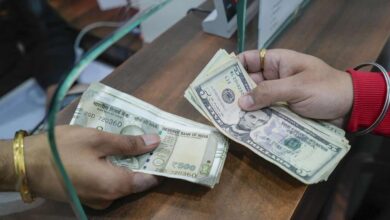
The Indian rupee demonstrated a strong recovery on Wednesday, halting a five-day decline to close at 90.38 against the US dollar, marking a gain of 55 paise. This rebound is attributed to what analysts perceive as aggressive intervention by the Reserve Bank of India (RBI). After a weak opening at 91.05 per dollar, the rupee rallied to an intraday high of 89.96, staging a significant comeback from its record low of 91.14 reached just a day earlier.
RBI’s Intervention Sparks Recovery
Bankers reported that the RBI played a critical role in the rupee’s resurgence by selling dollars to stabilize the currency. This action followed a considerable decline in the rupee’s value during previous sessions. The domestic currency improved to an intraday high of 89.75 on the interbank order-matching system, recovering from levels near 91.00 ahead of the RBI’s involvement. This strategy is consistent with the central bank’s prior interventions in October and November, where it sold dollars heavily in both spot and non-deliverable forward markets to counter ongoing downward trends. Unlike earlier actions conducted before market hours, the RBI’s dollar sales on Wednesday began shortly after onshore trading commenced, indicating a proactive stance to halt the rupee’s downward slide.
Dilip Parmar, a research analyst at HDFC Securities, mentioned that while the rupee’s appreciation is encouraging, volatility in the currency market is likely to persist. He noted that the USD/INR faces immediate resistance at 90.60 and support at 89.70, suggesting caution for traders in the current climate.
Factors Behind the Rupee’s Decline
The recent weakness of the rupee has primarily been linked to external factors instead of domestic economic conditions. Analysts indicated that the rupee is one of the worst-performing currencies globally this year, having depreciated nearly 6 percent against the dollar. This decrease has been intensified by a growing trade deficit, high US tariffs, and ongoing investment outflows. Experts noted that no other currency has suffered as much from US tariffs as the Indian rupee, and uncertainty regarding US-India trade negotiations has made investors cautious.
Deepak Agrawal, Chief Investment Officer at Kotak Mutual Fund, highlighted that the rupee’s record low against the dollar was mainly driven by external pressures, not weaknesses within the domestic economy. He pointed to persistent capital outflows and increased dollar demand associated with non-deliverable forward maturities as significant factors in the rupee’s decline. Despite India’s solid GDP growth and healthy foreign exchange reserves, stalled progress in trade talks with the US and continued foreign portfolio selling have adversely impacted market sentiment.
Market Reactions and Future Outlook
The dollar index climbed by 0.42 percent to 98.56, while Brent crude prices rose by 2.09 percent to USD 60.16 per barrel. Domestic equity markets also reacted negatively, with the Sensex falling 120.21 points to close at 84,559.65, and the Nifty slipping 41.55 points to 25,818.55. Moreover, foreign institutional investors sold equities worth Rs 2,381.92 crore on Tuesday, reflecting the cautious sentiment among investors.
Looking forward, analysts believe that the RBI’s focus will remain on curbing volatility rather than defending a specific exchange rate level. They suggest that the rupee could strengthen in the future if a trade deal with the US is finalized and capital flows improve. Current market dynamics indicate that although the rupee has shown resilience, ongoing external pressures will continue to shape its performance in the foreseeable future.
Digihunt is not a financial advisor and this is not investment advice.