
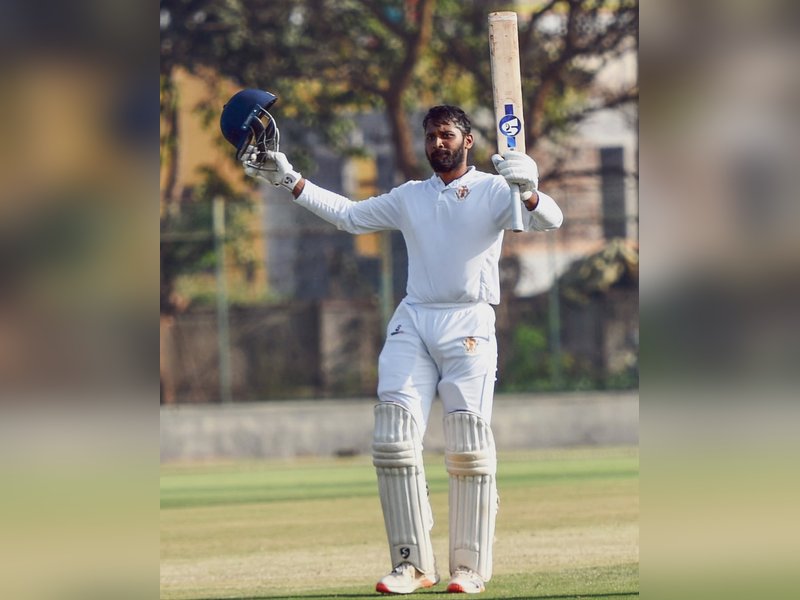
Smaran Ravichandran has never been interested in choosing between formats. For the 22-year-old, the goal has always been to excel as a batter in all three formats of the game.
“The goal right from the beginning when I started playing was to focus on all three formats and to become an all-format player for the country has always been my goal. All my work ethics and all the preparation that goes in during the off-season goes into all the three formats and not just one particular format. Yes, I would lay emphasis more on the red-ball aspect in order to play Tests for the country. But I think it’s equally important to focus on the other two formats as well. As I said, my goal has always been to represent the country in all three formats. So I think even now my preparation and everything that I do will go into getting my team through across all three formats,” Smaran shared in an exclusive conversation ahead of the Vijay Hazare Trophy, where Karnataka enters as defending champions.
This declaration is ambitious, considering that playing all three formats as a batter is rare due to hectic scheduling. However, it is supported by numbers that suggest Smaran is walking the talk. After a challenging start to his first-class career, he has quickly become one of the closely followed batters in Indian cricket, thanks to his ability to adjust seamlessly between formats.
His rise to public memory came in last season’s Vijay Hazare Trophy, where he amassed 432 runs, including a match-winning century in the final. He ended the last Ranji season with scores of 203, 35 & 133 not out, and also had notable scores of 77 & 10, 3, 220 not out, 54 & 4, and 227 not out.
In that Vijay Hazare Trophy final against Vidarbha in Vadodara, Karnataka were struggling early on a pitch conducive to batting. However, Smaran, playing in his first senior final for the state, recognized the opportunity to do something special.
“We were three down for 60-65 odd runs (67/3). As I recollect, the wicket was good to bat and just needed one partnership to get the team through. Me and (KL) Shrijith (who made 78) got a really big partnership to take it forward from there. With Abhinav (Manohar) coming in at the end and giving us those hits, we got to a very good score of 350 or 348 if I’m not wrong. Lifting the trophy for Karnataka has always been the dream. I’m glad that we did it and now heading into this Vijay Hazare Trophy, obviously, we are the defending champions and hopefully we can get another title home,” he added.
Smaran has no hesitation in stating that the 101 in that final ranks at the top of his list of best knocks in his career so far. It’s significant not only for the runs but for what it represented—Karnataka’s first domestic trophy in five years and his own arrival on the big stage.
His maiden first-class century, scored at M Chinnaswamy Stadium, comes a close second. It came in his sixth game after a lean opening phase, making the breakthrough particularly sweet.
As he heads into the upcoming Vijay Hazare Trophy, Smaran carries the momentum of having amassed 319 runs in seven innings at a strike rate of 158.70 for Karnataka in the recently concluded Syed Mushtaq Ali Trophy, although the team failed to qualify for the knockouts.
With a longer break available, Smaran had ample time to prepare for switching from 20-over cricket to 50-over format. After returning to chilly Bengaluru, he worked with his childhood coach Syed Zabiulla for a week to prepare for the Vijay Hazare Trophy, including playing a few practice games within the state’s setup.
Outside cricket, Smaran enjoys playing paddle and catching up on all kinds of movies in Hindi, English, and Kannada, with crime thrillers being his preferred genre. However, he recognizes that the transition from red-ball to white-ball cricket isn’t straightforward. In the Ranji Trophy, the focus is on occupying the crease for extended periods, while T20 cricket demands explosive bursts and immediate gear changes, often requiring 3-4 days of focus on quality power-hitting.
Moving from T20 to 50-over cricket feels more manageable for Smaran. “In the Ranji Trophy, you focus on playing the entire day or one and a half days. The focus is to stay at the crease. But in T20s, it’s about those short bursts of runs, and the intensity is higher, and you straight away switch into different gears. So that was challenging. Heading into Vijay Hazare, the switch is going to be easier compared to when we switched from Ranji Trophy to Mushtaq Ali because it’s still the white-ball format. Obviously, in the 50-over format, you have that extra time to settle down and take your time out there in the middle, unlike the T20 format.”
Smaran’s brief stint with Sunrisers Hyderabad (SRH) during this year’s IPL allowed him to interact with some of T20 cricket’s most destructive players. Although he wasn’t a direct replacement for Adam Zampa, Smaran reflected on how surreal it was to transition from watching IPL matches on television to sharing a dressing room with international stars.
Though his stint was cut short by an injury after tripping over an advertising hoarding while taking a catch during practice, the conversations he had with Heinrich Klaasen and Ishan Kishan were invaluable for Smaran, who stands just shy of six feet and possesses the natural ability to clear the boundary. His strength lies square of the wicket—a result of his sharp length detection and assured back-foot play.
“I spoke to Klaasen and had conversations with Ishan regarding how they approach the game in T20 format. A lot of valuable inputs came from Klaasen about how he stays still and maintains a solid base while hitting. Just conversations like that helped me improve my game,” he said.
Those insights are now part of his own game, as he continues to develop the power-hitting skills necessary in modern white-ball cricket. Growing up, he admired Kumar Sangakkara and Michael Hussey—two left-handers renowned for their adaptability across formats. Smaran recalls watching Sangakkara’s 287 against South Africa, part of a record 684-run partnership with Mahela Jayawardene, and was left in awe of the patience and concentration required to bat for long periods in Tests.
“The ability to occupy the crease through extended phases is something I know I must continue developing. There are still phases of the game where during a Test match I feel the urge to play aggressive shots. That is something that I still have to work on. Yes, patience is a big aspect of Test cricket, but it’s still a work in progress. I try hard to bat long phases without losing concentration. It’s easy to say but hard to execute, and that’s something I need to keep in mind,” he explained.
While his cricketing career accelerates, Ravichandran hasn’t abandoned his academics. He is currently pursuing an MBA in finance at Ramaiah University in Bangalore after completing his B.Com degree. Balancing sports and education is a philosophy his parents have always insisted upon.
“Right from the beginning, they have been supportive of my journey and have allowed me the freedom to pursue both because, with the competition in the country, there is no guarantee in sports,” he says.
Are his parents satisfied with his progress in cricket? “The answer is no because there is still a long way to go. My mom recently asked why I didn’t score runs in the last two games of the Mushtaq Ali Trophy. That’s the motivation my mom keeps giving me.”
Smaran’s cricketing journey started with a decision made by his mother—to keep her restless son engaged and outdoors. She enrolled him in a cricket coaching academy that opened nearby, hoping it would channel his energy.
“I always had an interest in cricket but didn’t know the intricacies of the game or how professional cricket worked. That’s when I met my coach and gradually progressed,” Smaran shared.
What began as a parenting strategy has laid the foundation for a promising cricket career. In his early years, Smaran was an all-rounder who bowled off-spin, although he now bowls significantly less. “I still bowl off-spin, but not as frequently. Until I was about 14 or 15, I played as an all-rounder. However, after I grew taller, I lost some accuracy in my off-spin.”
“But that is something I still want to work on because, as the game evolves, having multiple skills is important.”
Smaran represented Karnataka at every level, making his under-19 debut at just 15 and piling up runs in under-16 cricket. This early success fueled his ambition of representing India at the 2022 Under-19 World Cup. However, the Covid-19 pandemic intervened, suspending cricket worldwide.
When the game resumed, Smaran couldn’t make the cut for the tournament, which India eventually won. “That was something I really aimed for. My main goal was to represent India in the under-19 World Cup, but that didn’t happen. But it’s all part of the game. The game always has its ups and downs. After that, I realized my focus should be on representing Karnataka at the senior level and playing Ranji Trophy for the state,” he reflected, maintaining a polite tone rather than expressing frustration.
This recalibration paved the way for Smaran to break into the senior Karnataka team. “I’m glad I made my debut last year and I’m looking to build on that. My main goal is still to win many tournaments with Karnataka and any team I play for.”
For Smaran, personal milestones matter less than collective success. Watching Vinay Kumar lead Karnataka to back-to-back Ranji Trophy titles and trebles in 2013/14 and 2014/15 instilled in him a clear sense of the expectations from the current crop.
“To stand there in whites or any format and lift the trophy with Karnataka has been a dream. Returning Karnataka to its consistent winning ways will be my main priority. Hopefully, we can achieve that in the upcoming years and this season—we can win both trophies and bring them home. That’s definitely the goal, regardless of whether I’m the top scorer or not. As long as we bring the trophy back home, that’s the cherry on the cake,” he concluded.


