India’s Wealth Set to Surge: MoSL Projects $12 Trillion Growth in Coming Years

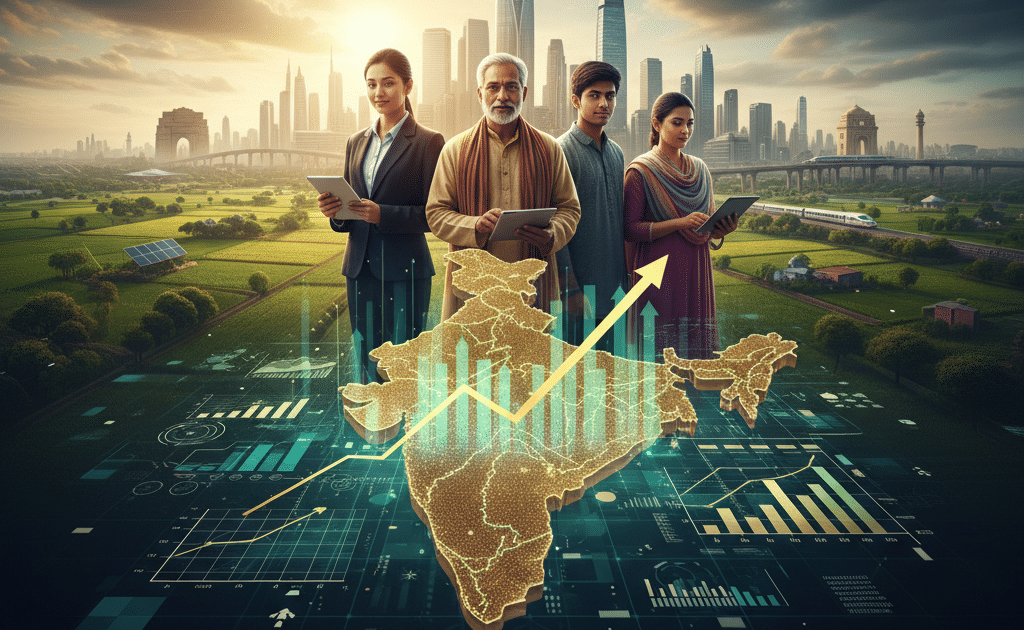
India is on the verge of a significant economic transformation, as indicated in Motilal Oswal Financial Services’ 30th Wealth Creation Study. The report forecasts a remarkable acceleration in the country’s economic growth and consumption patterns over the next 17 years. It compares the current growth cycle to the previous one, where India’s GDP rose from $1 trillion in 2008 to an anticipated $4 trillion by 2025, suggesting that the economy could reach $16 trillion by 2042. This transition is expected to create a stronger wealth effect, which will enhance consumption, investment, and corporate profitability.
Projected Economic Growth
The Motilal Oswal study reveals that the forthcoming economic cycle will be significantly more robust than its predecessor. While the last phase added $3 trillion to India’s GDP, the next phase is projected to contribute a striking $12 trillion. This substantial growth is likely to foster a wealth effect, elevating consumption levels and corporate profitability across various sectors. The financial services ecosystem is expected to play a crucial role in this expansion, with household savings projected to reach $47 trillion over the next 17 years. Financial institutions, including banks, non-banking financial companies (NBFCs), insurers, and wealth managers, will be instrumental in directing these savings into productive financial assets.
Impact on Per Capita Income and Consumption
Currently, India’s per capita income stands at approximately $2,600, but this figure is expected to quadruple to $10,400 by 2042. This increase will likely push millions of Indians into higher consumption brackets, impacting various sectors significantly. The study highlights that this transition will enhance discretionary spending in areas such as white goods, food-tech platforms, quick commerce, healthcare, travel, and telecommunications. As households pivot from necessity spending to lifestyle-driven consumption, the demand for these services and products is expected to rise sharply.
Automobile and Real Estate Growth Potential
The automobile sector is set for substantial growth, according to the study. Current penetration levels for cars, SUVs, two-wheelers, and three-wheelers in India remain low compared to peer economies with similar income levels. As affordability improves and financing options become more accessible, ownership ratios are expected to increase, particularly in urban and semi-urban areas. Furthermore, the real estate market is likely to benefit from rising household wealth and an increasing preference for quality housing. Demand for reliable developers, especially in the premium and luxury segments, is anticipated to remain strong, sustaining momentum in the sector.
Long-Term Opportunities Ahead
In summary, the Motilal Oswal Wealth Creation Study indicates that the next 17 years could usher in a transformative period for India’s economy and wealth landscape. With expansion taking place on a much larger base, the wealth effect is expected to impact more profoundly than in previous cycles. This transition will create long-term opportunities across various sectors, including financial services, consumption-driven industries, automobiles, and real estate, positioning India for a new era of economic prosperity.
Disclaimer: Digihunt is not a financial advisor, and this is not investment advice.