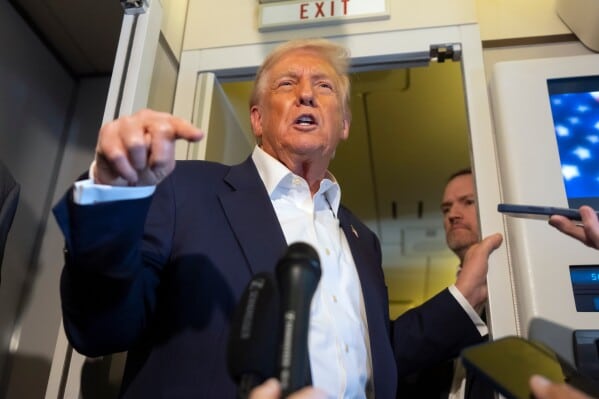
US President Donald Trump has often pointed to rising government revenues and significant investment commitments as proof of his effective economic strategy. However, many Americans are facing rising living costs, creating a disconnect between the administration’s optimistic claims and the financial struggles of households. Critics argue that while Trump showcases strong economic indicators, millions are still fighting to make ends meet in what economists describe as a “windchill economy,” where overall growth does not equate to improved financial conditions for individuals.
Investment Claims and Tariff Revenue
A central aspect of Trump’s economic narrative is his assertion that trillions of dollars are flowing into the United States due to tariffs and substantial corporate investments. In a recent interview, Trump stated, “We’ve got $18 trillion coming into our country. Biden had less than $1 trillion in four years.” Although these figures are often seen as exaggerated, there has indeed been a significant rise in tariff collections, surpassing $200 billion compared to the previous administration. Additionally, many companies and foreign governments have unveiled investment plans in the U.S., with total commitments amounting to trillions. As part of his ongoing strategy, Trump introduced a new $1 million “Gold Card” visa program that he believes could generate up to $1 trillion for the U.S. Treasury, further enhancing his claims of economic expansion.
Government Investments and Market Performance
Trump has also emphasized direct government investments in firms essential to national security. His administration has dedicated billions of taxpayer dollars to support these companies, arguing that such investments strengthen both the economy and national interests. He cites stock market gains as evidence that these investments are yielding positive outcomes, claiming a 10% stake in Intel has seen a significant increase in value. He remarked, “The price went through the roof. I made $40 million dollars. Nobody talks about that.” However, this narrative raises questions among critics regarding the sustainability of these claims.
Challenges of Economic Reality
Despite the administration’s optimistic forecasts, economists and critics argue that the financial landscape does not align with Trump’s assertions. While the additional $200 billion in tariff revenue is substantial, it represents a small portion of the $30 trillion economy. This revenue is inadequate for funding nationwide stimulus payments, eliminating income taxes, or making a significant impact on the $38 trillion national debt. Moreover, investment pledges are frequently non-binding, with companies historically announcing ambitious projects only to later scale them back. Even should all proposed projects come to fruition, the manufacturing sector is hindered by difficulties in finding workers, compounded by the effects of automation on job availability.
The Disconnect in Economic Messaging
Trump faces a political challenge in the disparity between favorable economic indicators and the real experiences of many Americans. He can cite growth and consumer spending, yet these figures resonate little with those struggling to meet their daily expenses. By emphasizing future gains and dismissing current affordability issues as a “con job,” Trump risks alienating individuals who prioritize immediate financial security over long-term forecasts. For many, the economy transcends balance sheets; it fundamentally revolves around their ability to afford basic necessities today.
Digihunt is not a financial advisor and this is not investment advice.