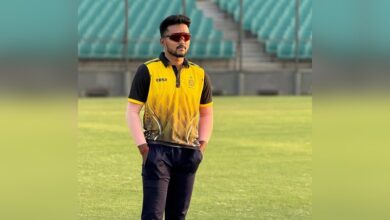
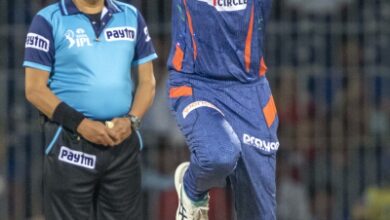
When Mangesh Yadav’s name flashed on the IPL 2026 auction broadcast in Abu Dhabi, Royal Challengers Bengaluru (RCB) and Sunrisers Hyderabad (SRH) engaged in a fierce bidding war that would forever change the left-arm quick’s life.
Within seconds, his price skyrocketed from a base price of Rs 30 lakh to an astonishing Rs 5.2 crore – a remarkable leap for a pacer. Mangesh, a skiddy left-arm pacer consistently clocking 140 km/h with a sharp yorker in his repertoire, could barely comprehend what had just unfolded.
“I was just thinking the first bid should happen and a team takes me in. I was very happy with the first bid from RCB. But within seconds in front of my eyes, SRH and RCB were bidding for me and it reached five crores, which was extremely astonishing. My parents back home were very happy. They were also getting calls from relatives,” recalled Mangesh in an exclusive conversation.
By the roadside in Noida, miles away from where his life was transforming, Phoolchand Sharma, who runs Wonders Cricket Club in Sector 34, was overjoyed. “I can’t tell you how happy I was on seeing him get selected. Before that, many of my kids have played in IPL, but there’s a different happiness for him. I hoped he would be picked by any franchise in the auction.”
“I have never met his father or mother, nor have I ever spoken to them. I have raised him like my own kid. He’s been a good boy from the start, a calm and hardworking kid. I gave him a lot of matches to play in Delhi, as well as in district leagues in Delhi and UP. He’s had a very long journey and is now seeing the fruits of being committed to that path,” he told.
Mangesh’s cricketing journey began in Borgaon village in Madhya Pradesh’s Chhindwara district, not in an established academy but in the compound of his home. As a six-year-old, he would return home in tears after fighting with boys while playing. His mother, Rita, found a solution: she would bowl to him in the compound, allowing him to bat for as long as he wanted.
“From there, I started playing cricket regularly and it went on and on. I started bowling a little late with the left arm. But I used to watch Mitchell Johnson and RP Singh sir bowling, and that served me with a lot of motivation,” he said.
As time passed, Mangesh’s talent became evident. In a family of six, including three sisters, his father Ramavadh drove trucks to make ends meet. Pursuing professional cricket seemed financially impossible until his maternal uncle convinced Ramavadh to let his son train seriously in cricket.
After that, Mangesh moved to Noida to train under Sharma. The hostel fee was Rs 20,000 per month, beyond his family’s reach. What happened next would alter Mangesh’s life trajectory. “Sir saw my game and he liked it. He forgave my fees and told me to stay here and practice, which was very helpful in my journey.”
“My father has done so much for me. I didn’t have any stress; I just wanted to play cricket. All the struggle was of my father. If it wasn’t for Phoolchand sir, I wouldn’t have been able to play cricket.”
The reality of Ramavadh’s sacrifice was always present for Mangesh. While he caught 4 AM trains for training and matches, his father arose at the same hour to begin another grueling shift behind the wheel—navigating treacherous roads through the night with no fixed schedule.
“My father’s struggle is unmatchable. I felt sad at times that I was going out to play while my father woke up daily in the morning to drive the truck through dangerous roads, though they are in much better condition now.”
The academy evolved alongside Mangesh, transitioning from basic facilities to a comprehensive setup featuring a gym, indoor nets, trainers, and coaches. Apart from Shivam Mavi and Bhuvneshwar Kumar, stars like Jasprit Bumrah, Ashish Nehra, and Hardik Pandya would drop in for net sessions at Sharma’s academy when in Delhi-NCR.
What struck Sharma was the rarity of discovering a left-arm quick whose natural bowling action didn’t require fundamental reconstruction. His action reminded Sharma of Zaheer Khan—smooth, repeatable, lethal.
“You do know that when a left-handed batter or bowler plays, there is an alag nazakat (different sheen) to it. Right from the rhythm of his run-up, he seemed like a perfect packaged bowler. We have to teach a lot of kids that you are running slow, head is falling over, and rhythm is not good.
“But when he used to run and bowl, it was perfect action, like Zaheer used to have. We worked on improvising it,” he added.
Small technical tweaks, combined with natural athleticism, gradually revealed a complete cricketer capable of consistently hitting 140 km/h. “He had many seniors to learn from, like Anureet Singh, who played in the IPL for years, Mavi, and Bhuvneshwar.”
“We caught some of his small shortcomings. We developed his bowling slowly. He is a good fielder from the start. While other kids went elsewhere, he would hit long sixes. His hitting power has been excellent,” he added.
Mangesh represented MP in U19 and U23 teams but feared opportunities were slipping away without a proper platform. Then came the Madhya Pradesh League—an initiative by current MPCA President Mahanaaryaman Scindia that proved transformative. Playing for Gwalior Cheetahs this year, Mangesh secured 14 wickets, becoming the tournament’s leading wicket-taker and catching IPL scouts’ attention.
“I thought I would be late in grabbing my opportunity, but Scindia ji introduced the MP League, and then I got the chance to perform. After my good performances this year, everything changed for me.”
Mangesh’s three mentors—Anand Rajan, Tanmay Srivastava, and Ankur Tyagi—also refined his game and mindset. Srivastava, an Under-19 World Cup winner for India in 2008 and now an active umpire, provided invaluable perspective, as did Rajan, who played for the state and in the IPL.
“I talk to Ankur Tyagi after every match—he is like a big brother to me. He has always supported and guided me the right way. Thanks to all three of them, I have always improved.”
Despite a disappointing debut in the Syed Mushtaq Ali Trophy (SMAT), MP head coach Chandrakant Pandit encouraged him to showcase his batting abilities in the second match against Punjab. Mangesh seized the opportunity, scoring 28 off 12 balls, demonstrating he was more than just a bowler.
“My first match wasn’t that good, but the captain backed me well because I was among the wickets. Pandit sir told me, ‘Mangesh, you will also have to do some batting.’ In the second game, he sent me up to bat, and I showcased my abilities, which felt really good.”
Before heading to Pune for the tournament’s Super League stage, Mangesh underwent trials with RCB, Delhi Capitals, Rajasthan Royals, and Mumbai Inddigihunt. Though he couldn’t attend SRH and PBKS trials due to a hectic schedule, the former’s bowling coach, ex-India pacer Varun Aaron, took note of his skills.
Now, joining RCB means sharing the dressing room with the iconic Virat Kohli—a childhood dream that Mangesh never thought possible. “I always wanted to play under Virat sir’s captaincy. But since he isn’t doing that, I feel sharing the dressing room with him is a big deal. I never imagined I would play alongside him, and this becoming a reality is a great feeling.”
His recent experience under Patidar’s captaincy during high-pressure SMAT games also keeps Mangesh in good stead. “Cricket is tough to think about, and playing in SMAT is pressure since you know players like Prabhsimran Singh and Ishan Kishan are hard to bowl to. But this was made easier by playing under Rajat bhaiya’s captaincy. The role he gave me helped me fulfill it.”
The visualization has already begun—Mangesh standing at the top of his run-up in RCB’s iconic red jersey with the new ball in hand, enough to give him goosebumps. But the ultimate dream remains wearing India’s blue jersey.
“How exciting it will be to wear the RCB jersey and have the ball in hand at the top of my run-up mark. I hope that this paves the way for me to wear the Indian team jersey and bowl the first ball for my country. That will be an out-of-this-world feeling.”
Rather than dwelling on IPL’s magnitude, Mangesh plans to focus on absorbing lessons from Kohli, Patidar, and Venkatesh Iyer to improve his craft. “We will have a team camp where I will prepare alongside Virat sir, Venky, and Rajat bhaiyas. I will learn from them by playing practice matches and improve along the way. I will be in touch with them, so it will be very helpful.”
What separates Mangesh from India’s impressive stable of fast bowlers, Sharma argues, isn’t just his left-arm pace—it’s his rare all-round capabilities.
“The biggest thing is that India has many fast bowlers, but you won’t get a perfect package like him. Arshdeep, Bumrah, Harshit Rana, Shami—these are all good bowlers who play for India.”
“But they won’t be batters or fielders like him. This isn’t favoritism; I’m speaking the language of cricket. As a cricketer, he is a perfect package. If God keeps him healthy, you will see him play for India in a year or two.”
The financial windfall from the life-changing IPL deal means Mangesh can fulfill his off-field aspirations. Marrying off his three sisters with grandeur tops his priority list, followed by easing his father’s decades of grueling truck-driving work and buying a house to end the family’s stay in a rented home.
His message to aspiring cricketers reflects hard-earned wisdom—that talent alone isn’t enough, that strong performances don’t guarantee selection, and that persistence matters more than immediate results.
“What I have felt through my cricketing journey is that without struggle, you won’t get anything. If you’re playing cricket, you’ll have to put in double the effort usually expected, as times come when you won’t be selected even if you perform well.”
“You definitely won’t be selected if you don’t perform well. So you have to accept that God is always watching you. Just work hard, and he will reward you at the right time.”
“You just have to be true to yourself and your efforts. My seniors always tell me to keep my head down and play cricket. It’s important to respect everyone and keep focused while on the field,” signed off Mangesh.