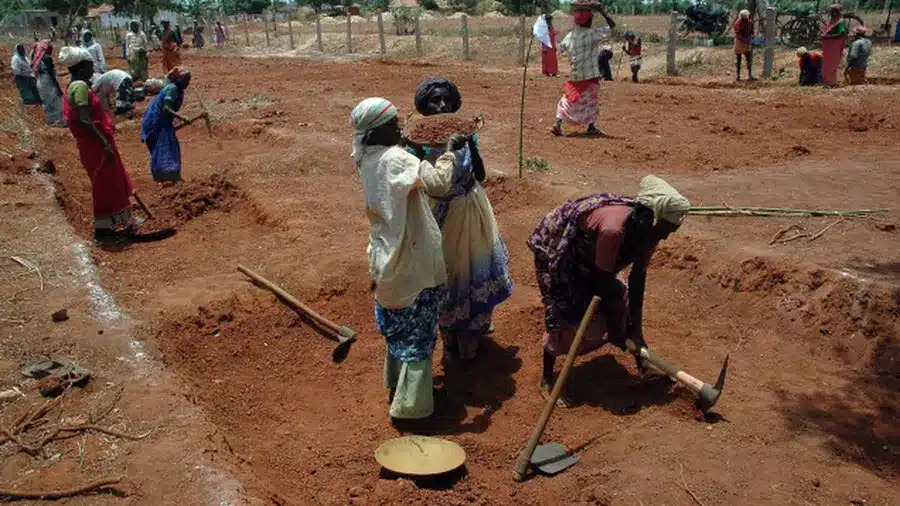
Less than 8% of families benefiting from the Mahatma Gandhi National Rural Employment Guarantee Act (MGNREGA) have secured the full 100 days of guaranteed work over the past three financial years, according to a recent government presentation at a parliamentary committee meeting. The average employment days per household during this period hovered around 50. Notably, participation rates among Scheduled Castes (SC), Scheduled Tribes (ST), and women workers in the rural employment scheme have been significantly higher than their population proportions, with figures indicating over 36% and 56% participation, respectively, in the current financial year.
Employment Trends Under MGNREGA
The data shared by the Ministry of Rural Development revealed that the average number of employment days per family this year stands at 36, a figure expected to increase as the financial year concludes. In the previous three years, the average ranged between 47 and 52 days. The number of families receiving employment under MGNREGA has been substantial, with estimates showing approximately 5.8 crore families in 2024-25, nearly 6 crore in 2023-24, and 6.2 crore in 2022-23. However, the number of families achieving the full 100 days of work was notably low, with only about 40.7 lakh (7%) in 2022-23, 45 lakh (7.5%) in 2023-24, and 36 lakh (5.8%) in the current year.
Concerns Raised by Committee Members
During the meeting, a Congress member criticized the government for reducing funding and delaying the release of financial resources. In contrast, BJP members highlighted financial irregularities in certain states and sought further details from the ministry. The discussions underscored the challenges faced by MGNREGA, including discrepancies between reported expenditures and actual physical progress, the use of machinery in labor-intensive jobs, and frequent bypassing of digital attendance systems. The government acknowledged these gaps and proposed a legislative reset through the VB-G RAM G Act to enhance the implementation framework of MGNREGA.
Focus on Ex-Servicemen’s Welfare
In a separate meeting, the parliamentary committee on defense addressed resettlement policies and healthcare for ex-servicemen. Rahul Gandhi, the Leader of the Opposition in the Lok Sabha, raised concerns about the difficulties retired personnel encounter in accessing medical care, particularly at private hospitals. He pointed out that some ex-servicemen are denied treatment due to outstanding dues with the government. Additionally, Gandhi advocated for increased financial assistance for certain categories of ex-servicemen suffering from severe illnesses, such as cancer, during the meeting chaired by BJP MP Radha Mohan Singh.
Digihunt is not a financial advisor and this is not investment advice.