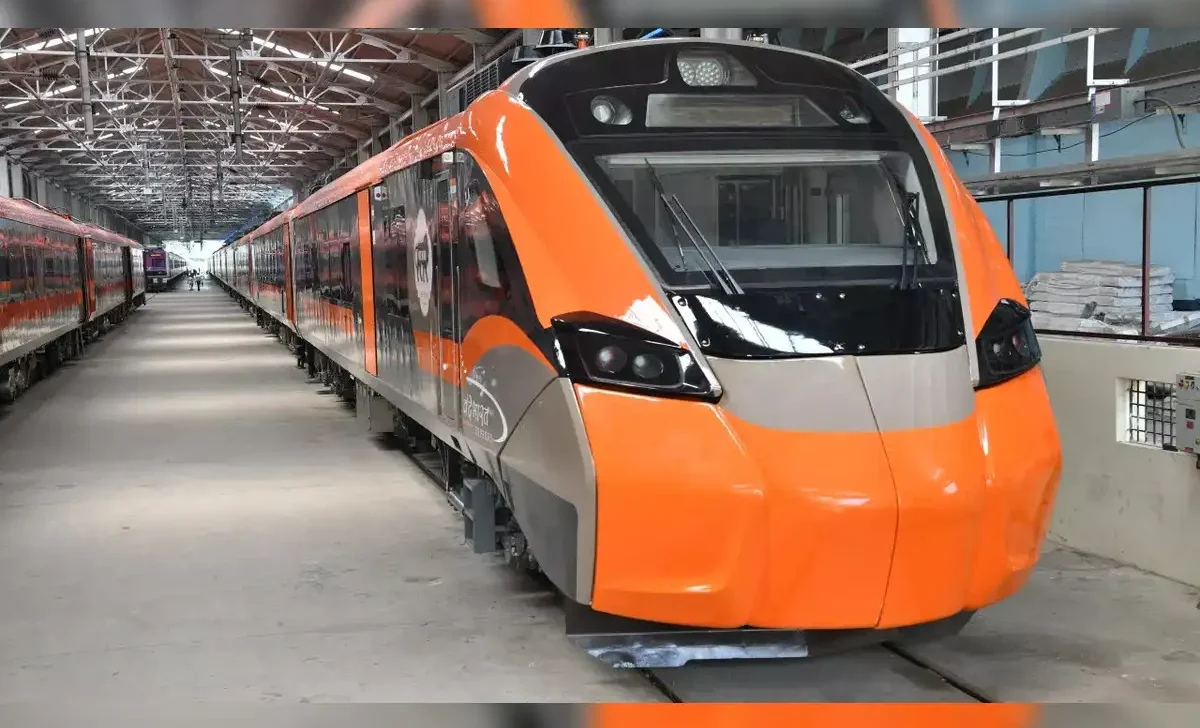
Railway Minister Ashwini Vaishnaw recently highlighted the significant advancements made in the development of the Vande Bharat sleeper train, showcasing its capabilities during speed trials. The train achieved a remarkable maximum speed of 180 km/h on the Kota-Nagda section of the Indian Railways network, with a demonstration that retained water glasses perfectly balanced throughout the test. This new sleeper variant aims to enhance long-distance travel across India, with plans for a wider rollout in the coming years.
Speed Trials and Testing
The Vande Bharat sleeper train has successfully completed its initial speed trials, reaching an impressive speed of 180 km/h. Railway Minister Ashwini Vaishnaw shared this milestone in a video posted on X (formerly Twitter), where he emphasized the train’s technological advancements. The trials were overseen by the Commissioner of Railway Safety, who monitored performance between the Kota and Nagda sections. A unique test showed that glasses of water remained undisturbed, highlighting the train’s smooth operation at high speeds.
Currently, two prototype rakes of the all-air-conditioned sleeper train are undergoing rigorous testing. Indian Railways is preparing for a significant transformation in long-distance rail travel, with plans to introduce over 200 Vande Bharat sleeper trains in the next few years. This initiative is backed by various manufacturing programs aimed at improving the rail network’s capacity and efficiency.
Manufacturing and Development Plans
The production of the Vande Bharat sleeper train involves collaboration among several key players in the industry. BEML, in partnership with the Integral Coach Factory (ICF), is developing ten sleeper train sets, while Kinet, a joint venture between Indian and Russian firms, is working on another ten sets. Additionally, a consortium consisting of Titagarh Rail Systems and BHEL has been awarded a contract to construct 80 sleeper variants. The ICF is also actively working on an in-house sleeper version of the Vande Bharat train, further diversifying options in this segment.
These developments are part of a larger strategy by Indian Railways to modernize its long-distance travel offerings. The introduction of the sleeper train is expected to provide passengers with a more comfortable and efficient travel experience, catering to the growing demand for overnight services.
Innovative Features of the Sleeper Train
The Vande Bharat sleeper train emphasizes passenger comfort and safety. The first two prototypes consist of 16 coaches, including 11 air-conditioned three-tier coaches, four air-conditioned two-tier coaches, and one air-conditioned first-class coach. Although the train is designed for semi-high-speed services, it can operate at speeds up to 160 km/h, with testing conducted at 180 km/h. Actual operating speeds will depend on track conditions across the Indian Railways network.
The sleeper coaches feature design elements inspired by European rolling stock, providing cushioned berths for added comfort. Amenities include low-intensity night lighting, audio announcements with visual displays, and CCTV surveillance for passenger safety. Advanced bio-vacuum toilets, accessible facilities for persons with disabilities, and shower cubicles are also included in the AC First Class coach.
Safety is a priority, incorporating indigenous KAVACH anti-collision technology and regenerative braking systems to enhance energy efficiency. Each coach comes equipped with fully sealed gangways, automatic interconnecting doors, individual reading lamps, charging sockets, and foldable refreshment tables. Furthermore, a Centralized Coach Monitoring System and emergency communication facilities will enhance the travel experience for passengers.
Digihunt is not a financial advisor and this is not investment advice.