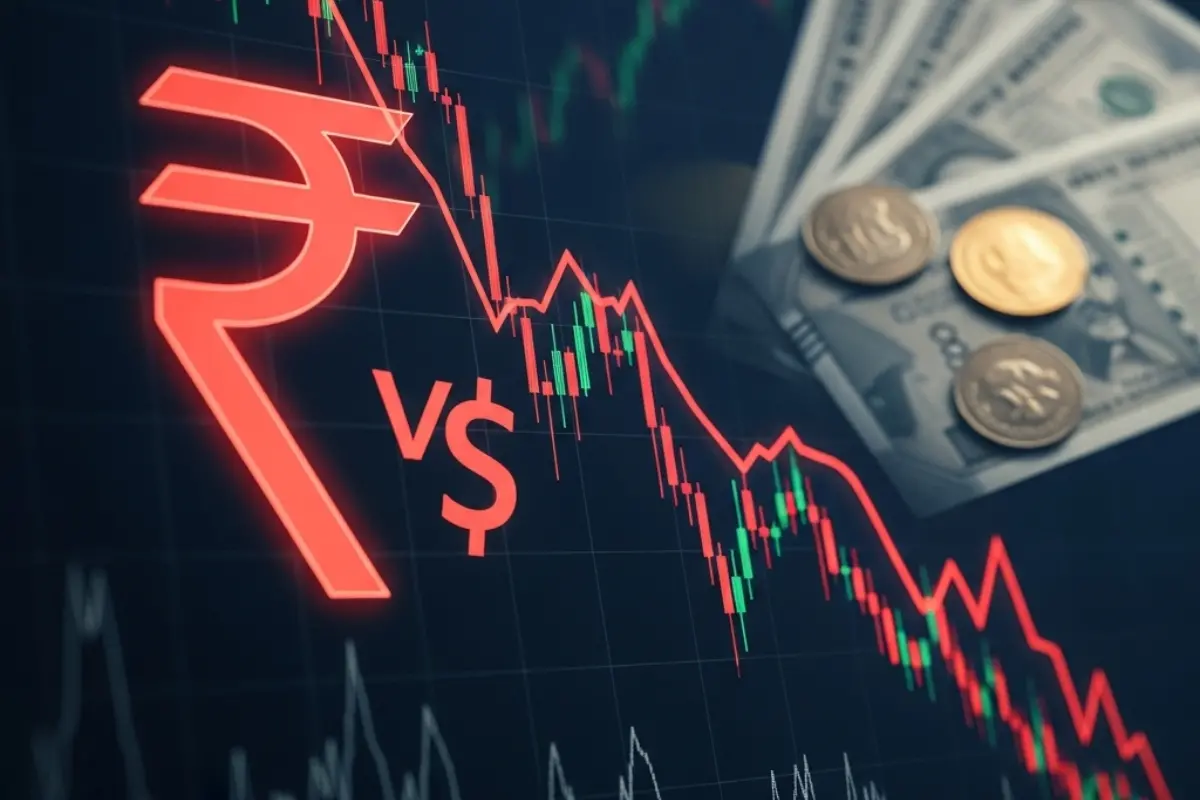
The Indian rupee is expected to experience considerable volatility until 2026. Analysts highlight that capital outflows, trade disruptions due to tariffs, and weak foreign investments could overshadow the country’s strong macroeconomic fundamentals. Despite steady growth and moderate inflation, the currency may not stabilize until uncertainties around tariffs are resolved. Notably, the rupee has already depreciated nearly 5% since January and has reached its historic low against the US dollar, making it the worst-performing currency in Asia.
Current State of the Rupee
This year has been particularly challenging for the Indian rupee, which has weakened against major currencies. Since breaching the 85-per-dollar mark in January, it has fallen past a historic low of 91 against the US dollar. In the past year, the rupee has depreciated over 19% against the euro, approximately 14% against the British pound, and over 5% against the Japanese yen. This slump occurred even as the dollar index fell by over 10%, and global crude oil prices remained weak. The rupee’s decline intensified following the announcement of reciprocal tariffs by former US President Donald Trump in April, prompting sustained foreign portfolio outflows as investors sought better returns elsewhere.
Impact of Foreign Investment
Investment flows into India present a concerning trend. From January to October of this year, foreign direct investment (FDI) turned negative, with total investment inflows declining to minus $0.010 billion, compared to $23 billion during the same period last year. Net FDI stood at $6.567 billion, while net portfolio investment was negative at minus $6.575 billion. Analysts emphasize that FDI is vital for the balance of payments; a decline in FDI increases the rupee’s dependence on portfolio flows, making it more sensitive to global risk sentiments. This situation has raised alarms about the currency’s stability as the rupee’s downward trend has accelerated in recent months.
Government and RBI Responses
The Indian government attributes the rupee’s depreciation to a widening trade deficit and delays in finalizing a trade agreement with the US. Minister of State for Finance Pankaj Chaudhary remarked that these factors have influenced the rupee’s decline. Meanwhile, Reserve Bank of India (RBI) Governor Sanjay Malhotra stated that the central bank does not target any specific exchange rate level. Analysts note that recent rate cuts aimed at supporting domestic growth have made the rupee less attractive. The RBI has also adopted a more flexible exchange rate regime, classified by the IMF as a “crawl-like” arrangement.
Future Outlook for the Rupee
Looking ahead, analysts predict that the current account deficit could widen to around 2% or more in 2026, driven by the full impact of US penalty tariffs on exports. While a trade pact with the US might provide some relief, it is not anticipated to be a comprehensive fix. Despite the near-term hurdles, experts believe that India’s growth trajectory and inflation profile will serve as a long-term foundation for the currency. Expectations indicate that the rupee may test levels of 92–93 amid global volatility in the coming months, with prospects for appreciation to levels of 83–84 by the end of FY27 as capital flows realign and dollar weakness becomes more evident.
Digihunt is not a financial advisor and this is not investment advice.