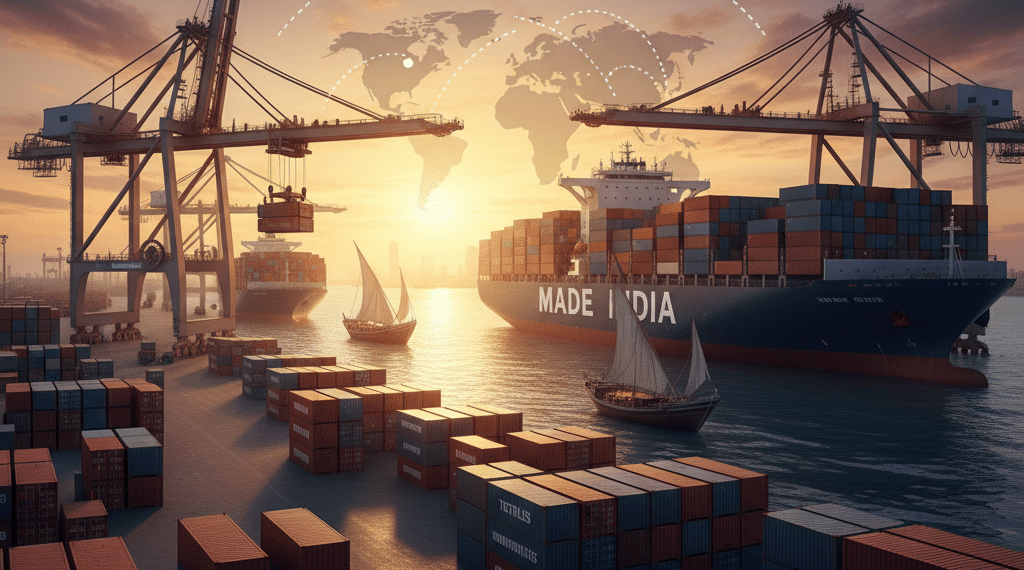
India’s aspiration to reach $1 trillion in goods and services exports by the end of fiscal year 2026 now seems increasingly unattainable, as highlighted in a report from the Global Trade Research Initiative (GTRI). The document indicates stagnation in merchandise exports, primarily attributed to sluggish global demand and rising protectionist measures. Ajay Shrivastava, the founder of GTRI, predicts that total exports will hit approximately $850 billion by FY26, falling short of the lofty target by $150 billion. Although services exports might exceed $400 billion, offering some support, the broader trade outlook remains challenging.
Challenges in Merchandise Exports
The GTRI report reveals that India’s merchandise exports are likely to show minimal growth this year. Shrivastava pointed out that while the domestic economic climate is stable, marked by low inflation and steady GDP growth, the pressure on GDP is significantly tied to the struggles within the export sector. The report suggests that achieving the $1 trillion target will rely on successful negotiations of significant trade agreements, particularly with the United States and the European Union. Shrivastava remains optimistic that these deals could potentially reshape the export landscape next year.
Shifts in Trade Dynamics with the US and EU
Amid the overall export slowdown, India is beginning to diversify its trade relationships. Recent data indicates a sharp decline in exports to the United States, down nearly 21% between May and November, mainly due to high tariffs imposed by the previous U.S. administration. The report cautions that without a rollback of these tariffs or a formal trade agreement, India’s exports to its largest market may continue to decrease. Conversely, trade with the European Union has also encountered challenges, with exports dropping nearly 24% due to compliance issues, along with the forthcoming implementation of the Carbon Border Adjustment Mechanism (CBAM) in 2026, which will add extra costs to Indian goods.
Diversification of Export Markets
Shrivastava noted a slight increase of 5.5% in exports to other global markets, indicative of a shift towards diversification. However, he warned that this geographical diversification must be paired with a broader range of export products. Currently, India’s export basket lacks adequate medium to high-tech items, which are critical for enhancing competitiveness. The GTRI report underscores the necessity of transitioning from merely signing Free Trade Agreements (FTAs) to ensuring these agreements produce tangible benefits, especially in sectors like electronics, engineering, and textiles.
Strategic Recommendations for 2026
Looking to the future, the GTRI stresses the importance of India adopting a more inward-focused export strategy, considering the limited influence over global geopolitical dynamics. Key recommendations include improving product quality, upgrading the value chain, and reducing production costs. The report identifies electronics, engineering, and textiles as sectors poised for notable growth, particularly in a challenging global trade landscape. Effectively leveraging trade agreements and focusing on policy execution aimed at simplifying regulations and enhancing the ease of doing business will be essential for sustaining export growth. The GTRI warns that ongoing tariffs, climate-related taxes, and geopolitical uncertainties will continue to be obstacles, underlining the need for a strong competitive edge in India’s export future.
Digihunt is not a financial advisor and this is not investment advice.