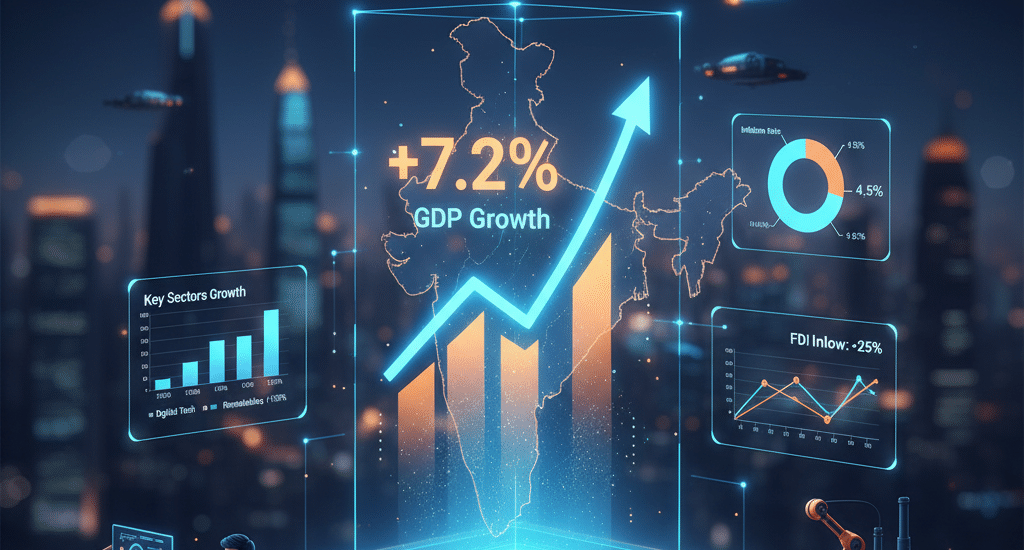
The Reserve Bank of India (RBI) has revised its growth forecast for the fiscal year 2025-26, now set at 7.3%. This increase reflects a strong economic recovery in the post-COVID environment, with real GDP growth projected at 7.8% and 8.2% for the first two quarters. Despite global economic uncertainties, India is expected to maintain a robust growth trajectory, bolstered by favorable domestic conditions and strategic fiscal policies.
Strong Economic Growth Projections
The RBI’s upward revision of the growth estimate to 7.3% for 2025-26 underscores India’s impressive economic recovery following the pandemic. The initial half of the fiscal year is expected to see real GDP growth rates of 7.8% and 8.2%, marking a significant rebound compared to the global average growth of 3.5% during the same timeframe. This growth is particularly noteworthy, coming after a solid base effect in the fiscal year 2021-22, which is excluded from the analysis. The RBI also predicts a growth rate of 6.8% for the first half of 2026-27, with an overall estimate for the fiscal year ranging from 6.5% to 6.8%. The International Monetary Fund (IMF) supports this optimism, forecasting a medium-term growth rate of 6.5% for India from 2027-28 to 2030-31.
Inflation and Monetary Policy Adjustments
Inflation in India has remained relatively low during the fiscal year 2025-26, with the RBI estimating a Consumer Price Index (CPI) inflation rate of 2%. This figure lies at the lower end of the Monetary Policy Committee’s tolerance range, enabling the RBI to implement a series of repo rate cuts totaling 100 basis points, bringing the rate down from 6.25% to 5.25%. These adjustments took place in three phases throughout the year, specifically in April, June, and December. The RBI’s emphasis on growth-oriented policies, coupled with anticipated supportive measures in the upcoming union budget for 2026-27, is expected to further enhance economic momentum.
Government Expenditure and Private Consumption
The Indian government has prioritized capital expenditure, achieving a remarkable growth rate of 32.4% in the first seven months of 2025-26, significantly exceeding the budgeted growth of 10.1%. This increase is crucial for sustaining economic growth. In addition, private final consumption expenditure (PFCE) has reported robust growth at 7.5%, driven by lower inflation, reduced interest rates, and increased household disposable income stemming from personal income tax rationalization. The government expects the momentum in PFCE to be further boosted by the extensive rate reductions under the Goods and Services Tax (GST) 2.0 initiative.
Challenges in Revenue Collection
Despite these positive growth indicators, the government encounters challenges in revenue collection. Data from November 2025 indicates a decline in gross and net GST collections compared to the previous year, suggesting potential revenue shortfalls. The growth in the government’s gross tax revenue (GTR) during April-October 2025-26 was only 4%, falling short of the budgeted annual growth of 10.8%. To avoid impacting the fiscal deficit, the government may need to reduce planned revenue expenditures. However, there is potential for increased revenue through higher-than-expected receipts from RBI dividends and newly introduced excise duties on certain goods. Maintaining the momentum of capital expenditure and adhering to fiscal consolidation will be essential for sustaining economic growth in the forthcoming fiscal years.
Digihunt is not a financial advisor and this is not investment advice.