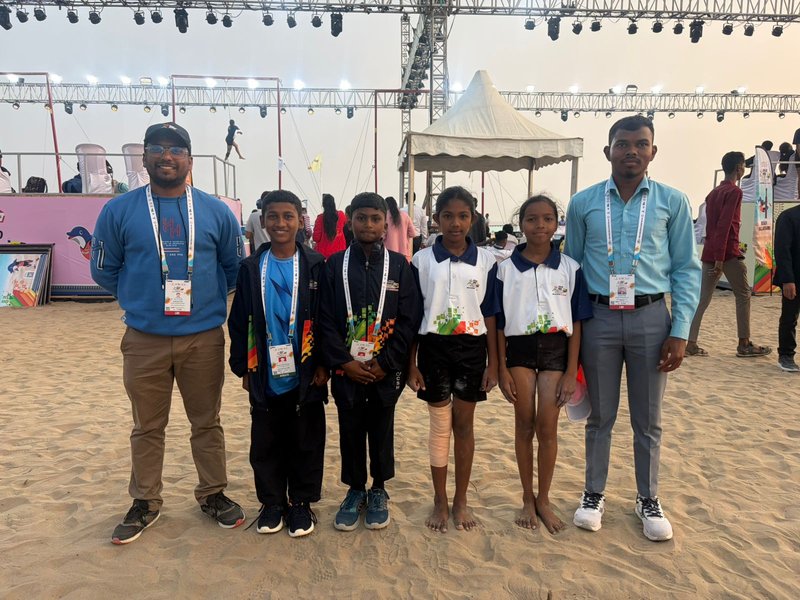
In the tribal heartlands of Dadra and Nagar Haveli and Daman and Diu, where sport has often taken a backseat to the struggle for daily survival, Mallakhamb is quietly reshaping lives. Once practiced in open fields and farmlands, this traditional Indian discipline has become a source of confidence, aspiration, and social change for children from some of the region’s most resource-constrained communities.
Coach Shubham Mair’s Role
At the forefront of this movement is Mallakhamb coach Shubham Mair, who arrived from Maharashtra’s Nashik district in 2019–20, appointed by the Khanvel Gram Panchayat on a contract basis. He serves as the head coach at the Mallakhamb Academy located in Shelti village of the Khanvel division.
When Shubham began his work in the Union Territory, he faced stark realities—no training facilities, no equipment, and no safety infrastructure. “There was nothing on the first day. The children trained in paddy fields, on bare ground, and sometimes even climbed trees. We had no poles, no mats, no oil or powder. What we did have was an extraordinary hunger to learn.”
Challenges Faced by Athletes
Most of the children had never heard of Mallakhamb before. Coming from tribal families that worked as daily wage laborers, sport was rarely seen as a career option. For families struggling to arrange two meals a day, structured training felt like a distant luxury.
A decisive shift occurred in 2019–20 when Shubham traveled to Panchkula, Haryana, for a preparatory camp ahead of the Khelo India Youth Games. The aim became clear: provide competitive exposure to emerging athletes who seldom get national-level opportunities. The immediate focus was not on medals but on experience—introducing children to competitive environments to help their confidence grow organically.
Institutional Support
This initiative has been strengthened by sustained institutional backing. Arun Gupta, Joint Secretary of Youth Affairs and Sports for Dadra and Nagar Haveli and Daman and Diu, emphasized that tribal sports development is a priority in the Union Territory, especially in Dadra & Nagar Haveli, where over 50 percent of the population belongs to tribal communities.
Gupta noted that a permanent Mallakhamb training center has been established at Khanvel, while a Khelo India State Centre of Excellence at Silvassa supports archery, athletics, and table tennis, providing residential facilities to nearly 75 athletes, most from tribal backgrounds. He added that world-class sports infrastructure—including stadiums and high-performance facilities—is being developed across Diu, Daman, and Dadra & Nagar Haveli, creating structured pathways for young talent from remote regions.
Visible Impact
For Shubham and his athletes, the benefits of this support are already evident. Guidance from senior coaches visiting from Nashik has helped formalize training methods, while regular competitions have sharpened their skills.
At the Khelo India Beach Games 2026, Shubham has brought a group of six boys and six girls, many experiencing a multi-sport event of this scale for the first time. “When children compete here, they realize they are no different from athletes of other states. That belief changes everything,” he said.
Among them is 12-year-old Kavya, who discovered Mallakhamb through school. “When it was introduced in Class VII, I became interested,” she stated. “Sir told us that with hard work, we can achieve something.”
Eleven-year-old Trusha shares this sentiment. Her father works as a hotel cook, while her mother manages the household. “My siblings don’t practice Mallakhamb, but I want to,” she said, smiling shyly.
For these girls, Mallakhamb is not merely physical exercise; it’s a pathway to identity and self-confidence. However, challenges remain. The lack of women coaches continues to limit girls’ participation, especially as the sport requires physical assistance during training.
“After a certain age, male coaches cannot train girls,” Shubham explained. “Social factors and the absence of female coaches mean many girls miss out.”
A Strong Resolve
Despite these challenges, the resolve remains firm. Coaches and administrators are working towards ensuring equal opportunities. The belief is straightforward yet powerful: talent exists, even where resources are lacking.
“These children may not have facilities at home, but they have immense potential. With guidance and opportunity, they can go far,” Shubham emphasized.